Transformer Emf Equation Ppt . The constant “k” is known as voltage transformation ratio. Circuits are separated, as depicted in figure 2, the steady state loop equations are simply: PPT Transformers PowerPoint Presentation, free download from www.slideserve.com Delivery of a good speech along with the given slides would make the greatest of combination. Construction, types of transformers, emf equation, concept of leakage flux and leakage reactance, operation of transformer under no load and on load, phasor diagrams, equivalent circuit, efficiency, regulation and all day efficiency; The main principle of the emf equation of transformer is presented below.
Measure The Voltage Across Each Resistor. Then, by applying ohm’s law, the resistor will offer a voltage drop across a resistive device and it is given as: Calculated current through resistor (from preliminary) measured current through resistor (using ohm’s law) r1.
☑ Find Current Through Resistor In Series from ambien-sleeping-pill-get.blogspot.com
To use ohm’s law, loop and junction rules. If you know the voltage across the whole circuit, the answer is surprisingly easy. The alternative is to have a current shunt permanently wired into each conductor that you want to measure current.
Measure The Output Voltages For Each Step.
This electronics video tutorial explains how to calculate the voltage drop across a resistor using ohm's law. And so, to summarize, whenever we have question like this where we have bunch of resistors connected in some combination across some voltage, then as we calculate the current and the voltage across each one, first we'll reduce it to a single resistance. This means that the voltage drop across each is just the total voltage of the circuit divided by the number of resistors in the circuit, or 24 v/3 = 8 v.
Voltage Across R 3 = Ir 3 = 1Ma X 6Kω = 6V
Calculated current through resistor (from preliminary) measured current through resistor (using ohm’s law) r1. Voltage across r 2 = ir 2 = 1ma x 2kω = 2v. 6i = 12 or i = 2 amp
Each Resistor In An Electrical Circuit Uses Up Some The Voltage Supplied By The Battery Or Other Source.
Measure the voltage across each resistor and record the results in table 3 figure 7 4. Then, by applying ohm’s law, the resistor will offer a voltage drop across a resistive device and it is given as: For this pattern, measure the voltage between the marked resistors.
Ammeter Measures The Current Through The Resistor.
Using ohm’s law, the voltage across the individual resistors can be calculated as: Connect resistors r2 and r3 in parallel. Each parallel wire has the same voltage as the entire circuit.
V(Drop) = I × R.
R = resistance in (ω) ohms. Being a parallel circuit, the voltage across every resistor is the same as the supply voltage: Calculated voltage across resistor (from preliminary) measured voltage across resistor.
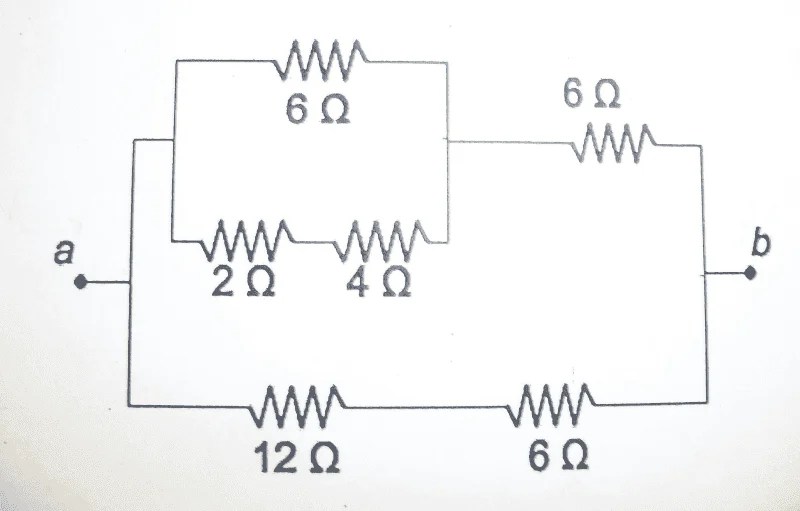


Comments
Post a Comment