Transformer Emf Equation Ppt . The constant “k” is known as voltage transformation ratio. Circuits are separated, as depicted in figure 2, the steady state loop equations are simply: PPT Transformers PowerPoint Presentation, free download from www.slideserve.com Delivery of a good speech along with the given slides would make the greatest of combination. Construction, types of transformers, emf equation, concept of leakage flux and leakage reactance, operation of transformer under no load and on load, phasor diagrams, equivalent circuit, efficiency, regulation and all day efficiency; The main principle of the emf equation of transformer is presented below.
What Is Excitation Current In A Generator. Rating of excitation current controls the terminal voltage level. Both are the main control systems for the generator set.
Excitation Selections Cat Caterpillar from www.cat.com
This article explains the working of exciters and the types of exciters used. Which of the ff components of a dc generator plays vital role for providing direct current of a dc generator? What classification is given to a generator that receives its field excitation current from internal source?
For Large, Or Older, Generators, It Is Usual For A Separate Exciter Dynamo To Be Powered In Parallel With The Main Power Generator.
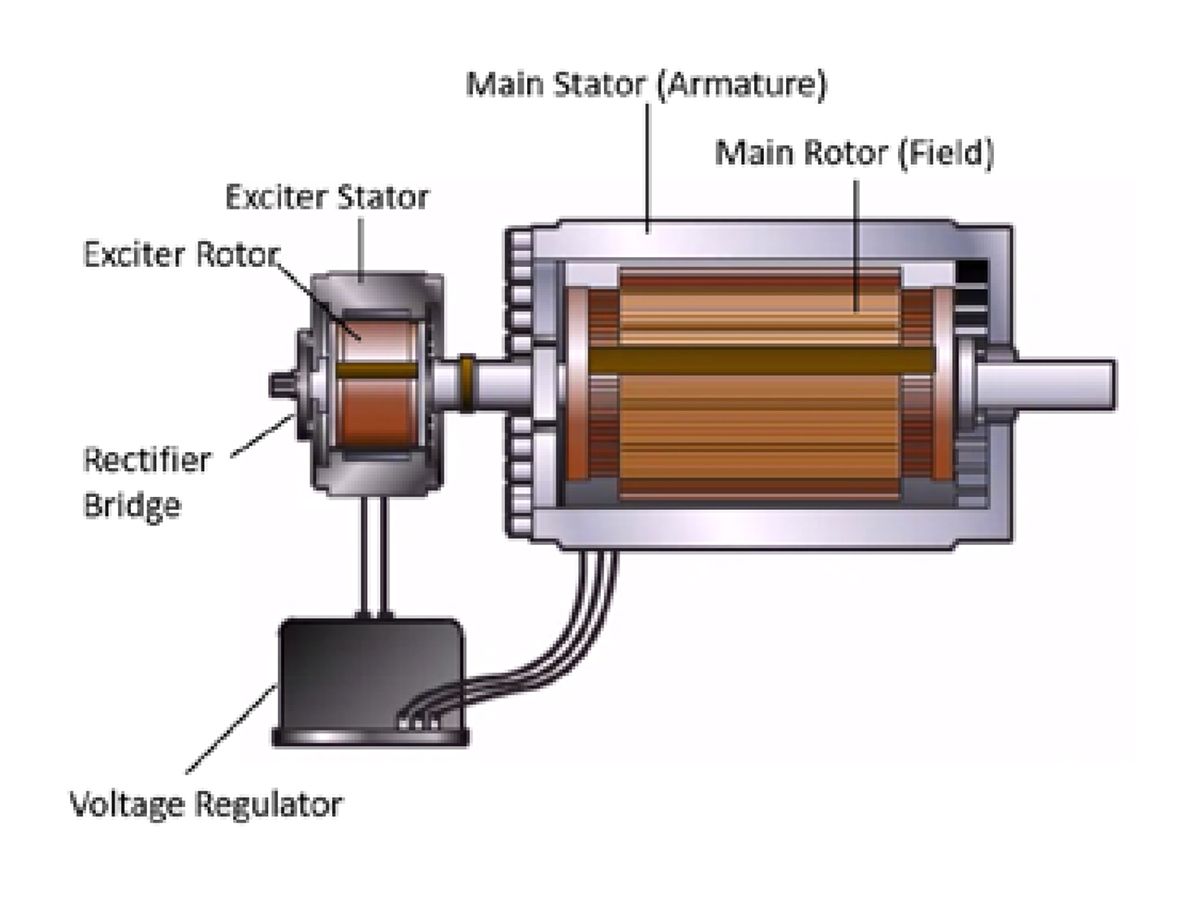
Excitation current is required by transformer to sustain a magnetic field inside the core and is largely independent of the secondary load. The basic function of an excitation system is to provide a continuous (dc) current to the field winding of a synchronous machine. The excitation system is the single unit in which the each alternator has its exciter in the form of generator.
Which Of The Ff Components Of A Dc Generator Plays Vital Role For Providing Direct Current Of A Dc Generator?
Both are the main control systems for the generator set. The excitation system senses this decrease in voltage and For high speed generators,normally it used a gearbox to reduce the exciter speed to standard speed around 700 until 1000 r.p.m.the main purpose for this method is to avoid commutation have a.
This Is Accomplished By The Generator Excitation System.
When the output voltage shifts, the input from the meter changes the signal to the voltage regulator. What classification is given to a generator that receives its field excitation current from internal source? Generators turn mechanical energy into electrical energy by moving electrical conductors in a magnetic field.
Synchronous Generator Excitation Voltage Is The Voltage Measured At The Generator Terminals When The Load Current Is Equal To Zero.
The excitation system is the single unit in which the each alternator has its exciter in the form of generator. This magnetic field is produced by the rotor’s field coils, and in order for electricity to be produced, a current must flow in the coils to generate the field. The output voltage of an alternator depends upon the magnetic field and so the excitation voltage.
If Not Enough Current Flows In This Field To Drive Rotating Assy, The Generators Output Can Be Unstable.
In addition, the speed control system controls the speed (frequency) and active power of the prime mover and generator. Coupling an excitation system to the same shaft as the rotor provides this field current, and enables the rotor to force the movement of electric charges. Emerson’s rich dennis provided a basics presentation on excitation control at the 2017 ovation user group meeting.


Comments
Post a Comment